

Dubai’s oil and gas industry is a cornerstone of the city’s economic landscape, shaping its growth and global influence. From the biggest petroleum companies to local oil and gas companies in Dubai, this sector has played a pivotal role in transforming the emirate into a thriving metropolis. The Dubai oil industry has not only fueled the city’s rapid development but also positioned it as a key player in the global energy market.
This comprehensive guide delves into the multifaceted world of the oil and gas industry in Dubai. It explores the sector’s historical evolution, showcases major oil companies in the UAE, and examines the robust infrastructure supporting the industry. The article also sheds light on the regulatory framework, challenges, and opportunities within the field. Additionally, it touches upon the attractive oil and gas salary in Dubai and highlights the importance of specialized training courses in Dubai to nurture talent in this dynamic sector.
Historical Development of Dubai’s Oil and Gas Sector
The oil and gas industry in Dubai has played a pivotal role in shaping the emirate’s economic landscape. This sector’s evolution has been marked by significant discoveries, economic impacts, and key milestones that have transformed Dubai into a global energy hub.
Early discoveries
The journey of Dubai’s oil and gas sector began in 1966 when oil was first discovered at the offshore Fateh field. This discovery marked a turning point in Dubai’s history, setting the stage for its rapid development. In 1969, Dubai started exporting oil, with the first shipment from the Fateh field amounting to approximately 180,000 barrels. This event signalled Dubai’s entry into the global oil market and laid the foundation for its future prosperity.
Further exploration led to more discoveries. In 1978, drilling operations began at the Falah field, with production commencing in June. The following year, in March 1979, a new oil field was discovered at Rashid, further expanding Dubai’s oil reserves. The Margham field, discovered later, started production in 1984, adding to Dubai’s growing oil portfolio.
Impact on Dubai’s economy
The discovery of oil has had a profound impact on Dubai’s economy. It served as a catalyst for rapid development and modernization. Sheik Rashid bin Saeed Al Maktoum, the ruler of Dubai at the time, wisely used the oil revenue to improve the quality of life for his people. This approach set the stage for Dubai’s transformation from a small trading port to a global metropolis.
The oil sector’s growth led to the establishment of key institutions. In 1999, the Dubai government-owned Emirates National Oil Company (ENOC) opened its first oil refinery. This Dh1.5 billion facility, with a production capacity of 120,000 barrels per day, marked a significant step in Dubai’s oil industry development.

Key milestones
Several milestones have marked the evolution of Dubai’s oil and gas sector:
- 1966: First oil discovery at the offshore Fateh field
- 1969: Dubai’s first oil export
- 1978: Commencement of production at the Falah field
- 1979: Discovery and production start at the Rashid field
- 1984: Production begins at the Margham field
- 1999: ENOC opens its first oil refinery
With almost 4 billion barrels of oil, Dubai is now the UAE’s second-largest oil reserve holder. However, oil output in Dubai reached its highest point in 1991 at 410,000 barrels per day and has since decreased. This trend has prompted Dubai to diversify its economy, focusing on sectors such as tourism, real estate, and financial services to ensure sustainable growth beyond oil.
Major Oil and Gas Companies in Dubai
Dubai’s oil and gas industry is home to a diverse range of companies, from national giants to international players and specialized service providers. This vibrant ecosystem has played a crucial role in shaping the emirate’s economic landscape and positioning it as a key player in the global energy market.
National Oil Companies
At the forefront of Dubai’s oil and gas sector stands the Emirates National Oil Company (ENOC), a government-owned entity that has been instrumental in driving the industry’s growth. ENOC has expanded its operations beyond Dubai, establishing a presence in Saudi Arabia and other regional markets. Another significant player is Abu Dhabi Polymers Company (Borouge), which has made substantial contributions to the UAE’s petrochemical industry.
International Players
Dubai has attracted numerous international oil and gas companies, enhancing its position as a global energy hub. Some of the prominent international players operating in Dubai include:
- British Petroleum (BP): BP has a strong regional presence, with operations in the UAE and Oman.
- Shell: Another major international company with operations in the UAE and Oman.
- Halliburton: This American multinational corporation has established a significant presence in Dubai, serving the UAE, Saudi Arabia, and other regional markets.
- Schlumberger: A leading oilfield services company, Schlumberger has operations across the UAE, Saudi Arabia, and neighbouring countries.
- LUKOIL International: This Russian oil company has chosen Dubai as its base for international operations.
These international players bring valuable expertise, technology, and investment to Dubai’s oil and gas sector, fostering innovation and growth.
Service Providers
A robust network of service providers supports Dubai’s oil and gas industry, offering specialized services and solutions. Some notable service providers include:
- Wood: A global leader in consulting and engineering, serving the UAE, Saudi Arabia, and other regional markets.
- Sergas: Specializing in gas services, Sergas operates in the UAE and Saudi Arabia.
- Oilplus: A Dubai-based company offering specialized services to the oil and gas industry.
- APEX Technology: Providing technological solutions to the UAE sector.
- SNC-Lavalin: An engineering and construction firm with a strong presence in the UAE and neighbouring countries.
- Petrochem Middle East: A key player in the petrochemical industry based in Dubai.
- National Petroleum Construction Company (NPCC): A major EPC contractor for the oil and gas sector in the UAE.
These service providers offer a wide range of specialized services, including engineering, construction, consultancy, and technology solutions, supporting the operations of both national and international oil companies in Dubai and the broader region.
The presence of these diverse companies has created a thriving ecosystem in Dubai’s oil and gas industry, fostering innovation, knowledge transfer, and economic growth. This robust industry landscape has also led to attractive career opportunities, with competitive oil and gas salaries in Dubai drawing talent from around the world.
Dubai’s Oil and Gas Infrastructure
Dubai’s oil and gas infrastructure forms the backbone of its thriving energy sector, encompassing a network of oil fields, refineries, and storage facilities. This robust infrastructure has played a crucial role in positioning Dubai as a key player in the global energy market.
Oil Fields
Dubai’s offshore oil fields have been instrumental in fueling the emirate’s economic growth. The city manages five major offshore oil fields:
- Fateh Field: The oldest and largest, discovered in 1966 and operational since 1969. It boasts 47 platforms, including 31 satellite wellheads and 16 central complex platforms.
- South West Fateh Field: Discovered in 1972, it began production three years later. This field consists of 23 platforms, with 13 satellite wellhead platforms and 10 bridge-linked central complex platforms.
- Rashid Field: Discovered in 1973, it commenced full production in 1979. It comprises three platforms and six subsea pipelines.
- Falah Field: Discovered in 1972 and operational since 1978, it has four platforms and nine underwater pipelines.
- Jalilah Field: The newest addition, featuring two platforms and three subsea pipelines.
These fields, located approximately 60 miles offshore in the Arabian Gulf, are managed by Dubai Petroleum (DPE) and served by a supply base in Jebel Ali.
Refineries
Dubai’s refining capacity has expanded to meet its growing energy needs. Key refineries include:
- ENOC Processing Company LLC: Located in the Jebel Ali Free Zone, this refinery has played a significant role in processing crude oil.
- Emdad Terminal: A joint venture with BP and Shell, this facility at Jebel Ali receives, stores, and distributes aviation fuel to airports in Dubai and the Northern Emirates.
- Emirates Refining Company Limited: Situated in Sharjah Port, this refinery has contributed to the region’s refining capabilities.
Storage Facilities
Dubai has invested in state-of-the-art storage facilities to ensure a steady supply of oil and gas products:
- Margham Gas Plant and Field: Located 55 km from Dubai on the Dubai/Hatta road, it’s the largest onshore gas field in Dubai. Since 2008, it has functioned as a strategic gas storage facility, allowing Dubai to eliminate oil products for electricity generation and water desalination.
- Emarat’s Jebel Ali Terminal (JAT): A fully equipped terminal handling gasoline and gasoil delivery to service stations and commercial customers. It features storage tanks, pipelines, loading gantries, and LPG storage and bottling facilities.
- Fujairah Terminal: Strategically located outside the Straits of Hormuz, this terminal offers high-quality fuel storage and distribution facilities with 13 above-ground tanks for various products.
This comprehensive infrastructure has enabled Dubai to manage its oil and gas resources efficiently, supporting its economic growth and energy needs while positioning itself as a significant player in the global energy market.

Regulatory Framework and Government Policies
Dubai’s oil and gas industry operates within a complex regulatory framework governed by both federal and emirate-level authorities. This structure ensures the responsible development and management of the UAE’s valuable natural resources.
Key regulatory bodies
In the UAE, each emirate has the authority to regulate its oil and gas industry. The Supreme Petroleum Council (SPC) is the paramount body overseeing the petroleum sector in Abu Dhabi. Chaired by the ruler of Abu Dhabi, the SPC formulates, promulgates, and implements regulations in the petroleum industry. It also controls the financial framework and oversees royalty and tax assessment and collection.
In Dubai, the Dubai Supreme Council of Energy (DSCE) plays a crucial role in regulating and governing policy development and planning for the petroleum industry. Established in 2009, the DSCE coordinates with various government entities, including the Emirates National Oil Company and the Department of Petroleum Affairs, to ensure effective sector management.
Licensing and permits
Companies must obtain the necessary licenses and permits to operate in Dubai’s oil and gas sector. The process involves several steps:
- Conducting thorough market research
- Complying with local and international trade laws
- Registering the company name
- Applying for a UAE trade license regulated by the Department of Economic Development (DED)
- Obtaining additional approvals from the Supreme Petroleum Council for specific business activities
Preapprovals from the Ministry of Energy are required for crude oil trading. The SPC issues licenses for crude oil in the capital on behalf of the government of Abu Dhabi. Although oil concession agreements are not required to adhere to any specific format, the SPC uses a specific framework for licensing domestic and foreign oil businesses.
Environmental regulations
Environmental protection is a key concern in Dubai’s oil and gas industry. Federal Law No. 24 of 1999 for the Protection and Development of the Environment (Federal Environmental Law) governs environmental impact assessment (EIA) requirements. Companies must:
- Obtain licenses for starting projects, including environmental impact assessments
- Carry out periodic monitoring of environmental impacts resulting from activities in production fields and transportation routes.
- Prohibit the discharge of polluting substances into the water or land environment without proper safety measures.
- Possess a valid International Oil Pollution Prevention Certificate (IOPP)
- Maintain a registry for hazardous wastes and obtain written permits for their handling and disposal
These regulations ensure that the oil and gas industry in Dubai operates responsibly, balancing economic growth with environmental protection.
Challenges and Opportunities in Dubai’s Oil and Gas Industry
Dubai’s oil and gas industry faces a dynamic landscape of challenges and opportunities. As the emirate navigates the complexities of a global market, it works to adapt to changing industry dynamics while maintaining its position as a key player in the energy sector.
Market Fluctuations
One of the most significant challenges for oil and gas companies in Dubai is the volatility of global oil prices. These fluctuations directly impact profitability and add uncertainty to financial planning. Companies must navigate this volatility to maintain stability and ensure long-term success. This challenge requires agility and responsiveness to market conditions, pushing companies to develop strategies that can withstand price swings.
Technological Advancements
Technological progress threatens and offers opportunities for the oil and gas business in Dubai. The industry is all about digital technologies for optimizing operations, increasing efficiency, and improving safety. This involves collecting and analyzing data in real-time using cloud computing, Internet of Things (IoT) devices, and advanced analytics to make better decisions.
Artificial intelligence (AI) and machine learning are making both the exploration and production processes more efficient. They sift through mountains of data collected by seismic imaging, drones, and sensors. These technologies make reservoir modelling, predictive maintenance, and optimizing drilling operations easier.
However, staying ahead of technological trends requires continuous investment, and companies must adapt to remain competitive. The rise of the digital oilfield presents both a challenge and an opportunity as Dubai invests in digital technologies to improve the industry’s efficiency and productivity.
Sustainability Concerns
Sustainability has become a major priority for Dubai’s oil and gas industry. The emirate is committed to reducing its greenhouse gas emissions and increasing its use of renewable energy. This focus on environmental sustainability presents both challenges and opportunities.
Oil and gas companies face pressure to reduce carbon emissions and comply with increasingly stringent environmental regulations. This requires significant investment in new technologies and practices. However, it also opens up opportunities for innovation and leadership in sustainable energy solutions.
Dubai’s commitment to sustainability is evident in projects like Masdar City in Abu Dhabi and Dubai’s Sustainable City. These initiatives aim to set benchmarks for sustainability and offer replicable models for other major cities worldwide.
As the world grapples with climate change and energy security, Dubai’s oil and gas industry is at a crossroads. The emirate recognizes that while oil and gas will continue to play a vital role in the global energy mix for years, there’s a need to diversify and transition towards more sustainable energy sources. This balancing act presents unique challenges and positions Dubai as a leader in transitioning to a more sustainable energy future.
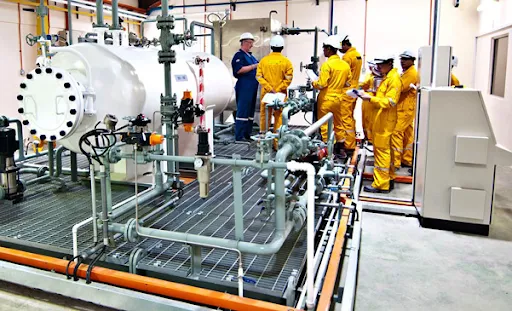
The Oil and Gas Sector of the UAE Offers Opportunities
The United Arab Emirates (UAE) is a powerhouse in the global oil and gas industry, ranking among the world’s top ten oil producers. With nearly 100 billion barrels of proven oil reserves, 96% of which are located in Abu Dhabi, the UAE has established itself as a major player in the energy sector. The country produces an average of 4 million barrels of petroleum and other liquids per day, making it the fourth-largest crude oil exporter in the region.
Why Should I Start an Oil and Gas Business in UAE?
The UAE offers numerous advantages for entrepreneurs looking to enter the oil and gas industry:
- Booming industry with plans to increase crude oil production to 5 million barrels per day by 2030
- World-class infrastructure and strategic location at the heart of trade routes
- No corporate or income taxation
- Simplified financial reporting
- Access to a talented workforce
- Easy company setup process
How Can You Open Your Oil and Gas Business in UAE?
To establish an oil and gas business in the UAE, follow these steps:
- Determine your company’s business activities
- Choose between onshore or free zone setup
- Prepare legal documents
- Apply the trade name
- Find a place to lease
- Receive your commercial license
- Open a corporate bank account
For onshore companies, you must choose between a local liability company (requiring a local sponsor) or a foreign branch office (requiring a national service agent). Free zone companies offer 100% foreign ownership and a straightforward incorporation process.
Requirements for an Oil and Gas Business in UAE
To operate in the UAE’s oil and gas sector, companies must obtain specific approvals and licenses:
- Supreme Petroleum Council Approval (SPC Approval) for certain oil and gas activities
- Trade license with additional activity for onshore and offshore oil and gas field services
- Approval from the Critical Infrastructure and Coastal Protection Authority (CICPA) for oil field access
Construction, drilling, staff catering, equipment trade, and associated oil and gas-related activities are among the business activities that necessitate specific approval from the Supreme Petroleum Council.
The UAE’s commitment to developing unconventional oil and gas production and aiming for self-sufficiency in gas supplies by 2030 presents endless business opportunities for investors in technologies, equipment, chemicals, machinery, and services.
Oil and Gas Training Courses in Dubai By Petroleum Training Partners
Petroleum Training Partners stands out as a leading organization in the oil and gas industry. It offers comprehensive training courses, consulting services, simulations, and seminars across Europe, Africa, North America, and the Middle East. Their presence in Dubai has played a crucial role in shaping the emirate’s oil and gas sector by providing top-notch education and skill development opportunities.
The organization’s training courses in Dubai cover various topics, catering to various aspects of the oil and gas industry. These courses are designed to enhance the knowledge and skills of professionals working in the field, from entry-level positions to senior management roles. By offering specialized training, Petroleum Training Partners helps to bridge the gap between theoretical knowledge and practical application in the industry.
One of Petroleum Training Partners’ key strengths is its use of cutting-edge simulation technologies. These simulations provide participants with hands-on experience in a controlled environment, allowing them to practice complex procedures and decision-making processes without the risks associated with real-world operations. This approach has proven highly effective in preparing professionals for the challenges they may face in their careers.
The organization’s training programs also focus on the latest trends and technologies in the oil and gas sector. This includes courses on renewable energy integration, digital transformation, and sustainable practices in the industry. By staying ahead of the curve, Petroleum Training Partners ensures that professionals in Dubai’s oil and gas sector remain competitive globally.
Furthermore, Petroleum Training Partners collaborates with major oil companies in the UAE and other regional petroleum companies to tailor their training programs to specific industry needs. This partnership approach has helped to create a more skilled and knowledgeable workforce, contributing to the growth and development of Dubai’s oil and gas industry.
As the biggest petroleum companies continue to invest in Dubai’s oil industry, the demand for well-trained professionals has increased. Petroleum Training Partners has responded to this need by expanding its course offerings and adapting its training methodologies to meet the sector’s evolving requirements. Follow Petroleum Trading & Training Partners on Facebook, Instagram, and LinkedIn for the latest updates.
Conclusion
Dubai’s oil and gas industry has a profound influence on the emirate’s economic landscape and global standing. From its humble beginnings to its current status as a major player in the global energy market, the sector has driven Dubai’s transformation into a thriving metropolis. The robust infrastructure, diverse ecosystem of companies, and forward-thinking regulatory framework have positioned Dubai as a hub for innovation and growth in the oil and gas industry.
As the industry faces market fluctuations and sustainability concerns, it also sees opportunities in technological advancements and the shift towards cleaner energy solutions. To stay ahead in this ever-changing landscape, professionals in the field can benefit from specialized training programs. Petroleum Training Partners offers comprehensive oil and gas training courses in Dubai to enhance skills and knowledge. To wrap up, Dubai’s oil and gas sector continues to evolve, adapting to global trends while maintaining its crucial role in the emirate’s economic success.
FAQs
1. How can one start a career in the oil and gas industry in Dubai?
To enter the oil and gas industry in Dubai, you must engage in various sectors such as construction, drilling, employee catering, and equipment trading, among other oil and gas-related activities. Additionally, accessing oil fields requires special approval from the Critical Infrastructure and Coastal Protection Authority (CICPA).
2. What should I understand about the oil and gas industry?
The oil and gas industry is crucial to the global economy, serving as the primary energy source worldwide. This industry is characterized by its complexity, the necessity for substantial capital investment, and the use of advanced technology in its operations.
3. What are the three main segments of the oil and gas industry?
The oil and gas industry is divided into three segments: Upstream, which involves exploration and production; Midstream, which focuses on transportation and storage; and Downstream, which deals with refining and marketing.
4. What is the strategic plan for oil and gas in the UAE?
The UAE Energy Strategy 2050 aims to balance economic needs and environmental goals by diversifying the energy mix. The strategy includes 44 per cent clean energy, 38 per cent gas, and 12 per cent clean coal.



Leave a Reply